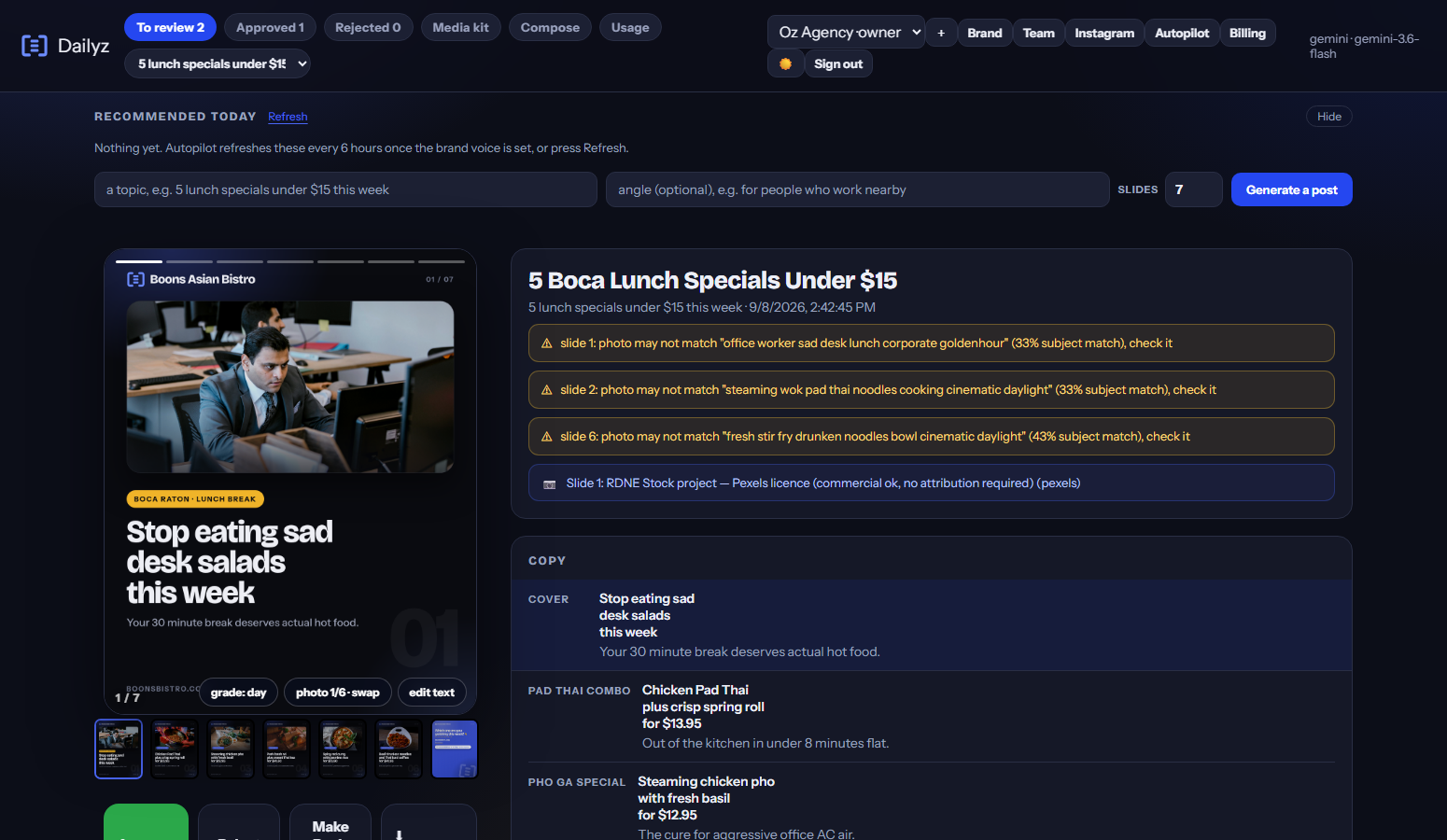
Every post is finished before anyone opens it.
Dailyz writes your carousels overnight, renders them in your brand at exactly 1080x1350, and files them in a queue where one person approves the day's work in about four minutes. The posts it cannot write, you build by hand on the same canvas. Both come out of the same brand code, so nothing ever leaves off brand.
In film, the dailies are the day's work: shot, processed overnight, and put in front of the one person who says yes or no the next morning. Same ritual, one letter different.
What it does
Four things, and it does them in this order.
These are screenshots of the real thing, not mockups. The posts inside them belong to sendoff.trips, the first brand running on it.
01
It does the writing while you sleep.
Point it at the list of things worth posting about: your products, your services, your calendar, your destinations. Every night it picks the next one, writes the whole seven-slide carousel in your voice, finds the photography, renders each slide, and leaves the finished post in a queue.
You wake up to work that is done, not to a blank template and a prompt box.
02
It tells you where it is unsure.
Most AI tools hand you output with total confidence and let you find the mistakes. Dailyz scores how well each photo actually matches what the slide is about and warns you, by name and by percentage, when it doubts itself. Swapping in a better shot is one keystroke, and it never calls the model again.
Photo credit and licence are printed on the post, so nobody has to guess whether an image is safe to publish.
03
You build the ones it cannot write.
Every generator has the same failure: it gets a post eighty percent right and there is no way to fix the last twenty without leaving the tool. So Dailyz ships the other half. Pick the layout, search or upload the photo, rewrite the text on the canvas, drop your own brand assets on as stickers, build up the carousel slide by slide.
The canvas is a real 1080x1350 frame, so what you see is genuinely what exports. A hand-made slide comes out pixel-identical to a machine-made one.
04
Your brand is code, not a hope.
Colours, typefaces, logo, the rules about where text sits and how a photo gets graded: all of it lives in one definition that both halves of the product render from. A five-person team can work in parallel and the feed still looks like one hand made it.
Your post formats live in the same place as finished examples, not wireframes. Copy the layout, swap the photo, ship it.
Why it is different
Everything else sits on one side of the line.
Generators
They write you a post and hand you a template to art-direct somewhere else. Fast to a draft, slow to something you would actually publish.
Design tools
They let you build anything and enforce nothing. Brand consistency is a hope and a shared folder, and it breaks the moment a second person opens the file.
Approval tools
They route sign-off over files somebody else already made. Useful, but they have never made a post in their life.
Dailyz
Generate what you can, hand-build what you cannot, and both come out of the same brand-locked renderer. That is the whole idea.
Straight answers
Where it actually is today.
You are pre-registering for something early. Here is exactly what that means, so nobody is surprised later.
- It runs live, every day, for one brand. Real posts, a real reviewer, real approvals and rejections.
- It does not post to Instagram for you yet. Approve means approve and export, and the export is a zip of the slides plus the caption.
- Onboarding a second brand is manual right now. That is the work the first group of users is funding.
- Photo search is only as good as the stock library. That is exactly why the hand-build half exists, and why you can upload your own photos.
- There is no price yet. Pre-registering costs nothing and commits you to nothing.
Who it is for